Damaged brickwork can affect more than your home’s appearance. Cracked bricks, crumbling mortar, spalling, and water damage can allow moisture into the masonry and contribute to more extensive deterioration. But does damaged brick always need to be replaced?
Not necessarily. Experienced masonry contractors can inspect the condition of the brickwork, identify the likely cause of the damage, and determine whether repair or replacement is the better option.
How Masonry Contractors Determine Whether Brick Needs Repair
The first step is a thorough inspection. A professional masonry contractor should look at more than the most obvious damaged brick.
The evaluation may consider:
- The size and location of cracks
- Deteriorated or missing mortar
- Spalling or flaking brick surfaces
- Signs of moisture or water intrusion
- Displacement or movement
- The age and condition of surrounding masonry
- Previous repairs and replacement materials
A single cracked brick may be relatively straightforward to replace, while widespread cracking or movement may indicate an underlying issue that needs further investigation.
When Brick Repair May Be the Better Option
Brick repair can make sense when the damage is limited and the surrounding masonry remains structurally sound.
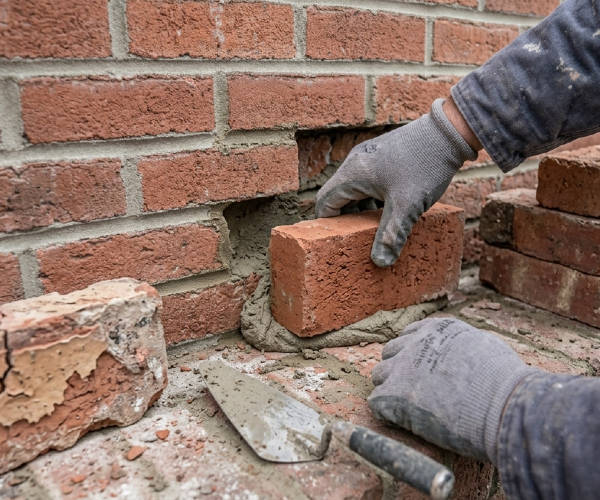
Depending on the condition, repairs may involve mortar repointing, crack repair, localized restoration, or replacing a small number of damaged units. Addressing deteriorated mortar can also help reduce moisture penetration and protect surrounding brickwork.
Repair may be preferable when the existing brick is still stable and the damage does not justify removing a larger section of the wall.
When Brick Replacement Is Necessary
Replacement may be appropriate when individual bricks are severely damaged or when deterioration has progressed beyond practical repair.
Common signs that replacement may be needed include:
- Deep structural cracks
- Severe spalling
- Bricks that are loose or displaced
- Extensive deterioration
- Repeated failure after previous repairs
- Damage caused by prolonged moisture exposure
The replacement brick should be selected carefully. Differences in size, color, texture, and absorption characteristics can make repairs stand out or create compatibility problems.
The Masonry Repair Process
A professional approach typically follows several steps.
1. Inspection: The affected masonry is evaluated to understand the extent and possible cause of the damage.
2. Repair Assessment: The contractor determines which bricks or mortar joints can remain and which areas require repair or replacement.
3. Material Selection: Replacement brick and mortar are selected to be as compatible as practical with the existing masonry.
4. Repair or Replacement: Damaged materials are carefully removed where necessary, and repairs are completed using appropriate masonry techniques.
5. Final Inspection: The completed work is checked for proper appearance, stability, mortar joints, and overall workmanship.
This process helps ensure that the repair addresses the actual masonry problem rather than simply covering visible damage.
Why Massachusetts Homeowners Should Address Damaged Brick
Massachusetts homes are exposed to rain, snow, freezing temperatures, and repeated freeze-thaw cycles. When moisture enters damaged masonry, freezing and expansion can contribute to further deterioration.
For this reason, homeowners should not ignore recurring cracks, deteriorating mortar, or spalling brick. Early evaluation can help identify problems before more extensive masonry restoration is required.
How to Choose Masonry Contractors for Brick Repair
When comparing masonry contractors, look for relevant brick repair and restoration experience rather than choosing solely on price.
Ask whether the contractor:
- Has completed similar brick repair projects
- Can explain the cause of the damage
- Uses compatible masonry materials
- Provides a detailed written estimate
- Can provide examples of previous work
- Carries appropriate insurance
- Understands local masonry conditions
A qualified contractor should be able to explain whether repair or replacement is appropriate and why.
Choose Baystate Masonry and Waterproofing
At Baystate Masonry and Waterproofing, we understand that damaged brick can have different causes and may require different solutions. Our approach focuses on evaluating the condition of the masonry and determining whether localized repair, brick replacement, mortar work, or more extensive restoration is appropriate.
Whether you’re dealing with cracked bricks, deteriorating mortar, spalling, or moisture-related masonry damage, professional evaluation can help you make an informed decision.